Acknowledgements & Credits
Malimbeconnect is a living workspace.
This site is partly a professional and scholarly workspace. Its ideas, practices, and resources continue to evolve through research, professional experience, learning, dialogue, and experimentation with emerging technologies.
Intellectual & Practice Foundations
I acknowledge the scholars, practitioners, researchers, and bodies of knowledge in Appreciative Inquiry (see acknowledgements) that have influenced my thinking and contributed to the development of my Appreciation-Based AI-5D Human-Centered Practice™, including work in:
- Appreciation-Based Practices
- Appreciative Intelligence
- Adaptive Organizational Change
- Adult learning and human development
- Leadership and professional development
- Organizational change and transformation
- Human-centered learning design
- Coaching and experiential learning
- AI and digital transformation
Technology & AI
I am actively exploring AI applications, tools, and emerging technologies as part of this living practice. AI supports research, exploration, brainstorming, writing, design, and experimentation. Human judgment, reflection, experience, and accountability remain central to how ideas are evaluated and applied.
Sources & Contributors
Where ideas, research, frameworks, images, quotations, or other materials are drawn from external sources, appropriate attribution and credits will be provided. I am committed to distinguishing my original contributions from ideas and resources that have informed or supported this work.
An Evolving Practice
This site is intentionally a work in progress. The Appreciation-Based AI-5D Human-Centered Practice™ will continue to develop as I learn, test, question, reflect, and explore new possibilities at the intersection of human potential, organizational change, and AI-enabled transformation.
With appreciation for the many people, ideas, experiences, and technologies that continue to shape the journey.
Acknowledgements
The Foundation of the Appreciation-Based AI-5D Framework™
This site builds upon concepts and insights developed through my doctoral dissertation research, which examined the application of an Appreciative Inquiry model within educational environments. That research provides an important foundation for the development of the Appreciation-Based AI-5D Human-Centered Framework™.
AI-5D extends appreciative principles into broader contexts of organizational change, human capability, adaptation, and AI-enabled transformation. The framework continues to evolve as I explore how appreciation-based approaches can help individuals and organizations recognize strengths, envision possibilities, and intentionally navigate an increasingly complex and technology-enabled world.
Theoretical Foundation
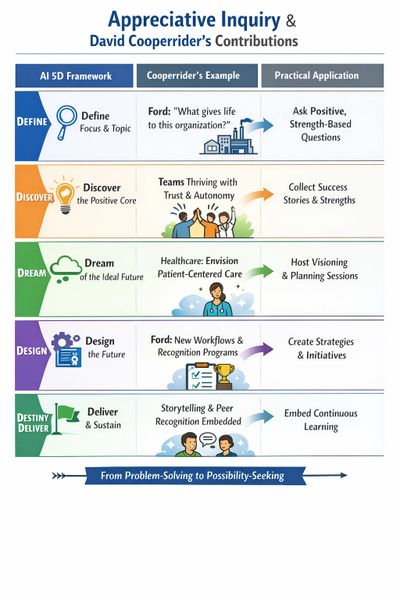
The Appreciation-Based AI-5D Human-Centered Framework™ is grounded in the foundational scholarship of David Cooperrider, PhD, and Appreciative Inquiry (AI)—a strengths-based approach to organizational development and change that focuses on what gives life to people, teams, and systems and what enables them to thrive.
AI-5D extends this foundation by bringing together appreciative inquiry, adaptive practice, human-centered design, systems thinking, and AI-enabled insight in a cyclical approach to change.
At its core is the belief that sustainable transformation begins by recognizing and engaging the strengths, experiences, relationships, knowledge, and potential already present within people and systems. The framework moves from appreciating what is and what is possible toward intentionally designing, adapting, and delivering what could be—while keeping human judgment, purpose, relationships, and meaning at the center.
stephanie j. davis
Principal | Human Development, Educator, Learning, Workforce Development and Organizational Change
Exploring the intersection of human potential, workforce development, learning, organizational change, and AI-enabled transformation, integrating appreciation-based principles, coaching, learning design, and human-centered approaches to help people recognize strengths, build capabilities, navigate transitions, and translate possibilities into meaningful action.
profile
CURRENT FOCUS
Human Development • Strength-Building Coaching • Advising • Workforce Development • Human-Centered Change
ACADEMIC
Ed.D. — Educational Leadership & Organizational Innovation (Completed May 2024). Dissertation: Appreciative Inquiry as an Organizational Change Model for teachers in an educational environment. A mixed-methods research methodology (quan/qual)
M.A. — Education & Human Development
FEDERAL / HHS
12 years | Learning • Leadership • Workforce Development • Educational Technology Coaching • Organizational Effectiveness
1,250+ employees | Enterprise programs
COACHING
136-hour ICF-accredited coach training (ACSTH)
126+ hours of Federal Leadership Coaching
Certifications: Everything DiSC, Core Strength (formerly SDI), The Five Behaviors of a Team, CliftonStrengths, FIRO-B, MBTI
LEARNING & TECHNOLOGY
LMS Administration • ISD/ADDIE/In-Person & Online Learning • Virtual and In-Person Facilitation • Adobe Connect •Zoom • GoToMeeting • Microsoft Teams • Canvas • SharePoint • Lectora. SPXX. Google Forms.
CONSULTING / L&D / Educational Technology
18+ years | Learning and Instructional System Design • Program Management • Workshops • Facilitation • Leadership Development • Organizational Change • Social & Behaviorial Research
HIGHER EDUCATION
Student Development • Student Support • Higher Education Administration