Scope of Practice Application
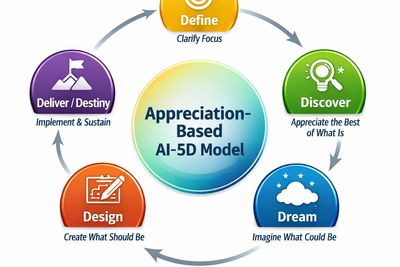
When organizations transform how work gets done, they create the conditions for people to perform at their highest potential. A core driver of this transformation is intentional, open questioning through an appreciation-based AI-5D human-centered practice—one that combines human insight, data, and technology to understand what is happening, uncover what is possible, and inform adaptive action.
As a Principal Adapter, I use the AI-5D human-centered construct to help individuals, teams, and organizations navigate complexity, interpret changing conditions, and translate insight into meaningful action. Data analysis, digital tools, and emerging AI technologies can augment this process by identifying patterns, surfacing trends, testing assumptions, and generating actionable insights—while human judgment, relationships, context, and purpose remain at the center.
Applied across the AI-5D Human-Centered Construct
Intentional and open questioning turns inquiry into actionable insight, strengthening adaptability, collaboration, learning, and innovation in AI-enabled digital environments.
What each phase uncovers:
- Define – Identify priorities, questions, and the conditions shaping the challenge.
- Discover – Uncover strengths, patterns, data, perspectives, AI and digital tools, and insights.
- Dream – Expand collective possibilities and envision what could be.
- Design – Translate insights and vision into adaptive systems, structures, solutions, and actions.
- Deliver/Destiny – Practice, test, reinforce, learn, and sustain transformation.
Throughout the process, data analysis and technological tools serve as amplifiers of human inquiry—not substitutes for human judgment. They help people and organizations make sense of what is happening, bring risks and opportunities to light, recognize patterns, improve decision-making, and identify what may be getting in the way of change.
The result is a more adaptive learning cycle: question → discover → interpret → design → act → learn → adapt.
© 2026 Stephanie J. Davis